MADISON, Wis. — Wisconsin’s basketball staffers had fewer than 36 hours last spring from the Badgers’ season ending in the NCAA Tournament to the transfer portal window opening. It was, as general manager Marc VandeWettering called it, “chaos” given how quickly roster decisions needed to come together. In the end, Wisconsin’s planning helped the Badgers field an entertaining 24-win team that finished fifth in the Big Ten.
This time, when the season ended March 19 in the first round of the NCAA Tournament with a disappointing loss to High Point, the runway to figure out how to turn the page was much longer. VandeWettering said that, with the transfer portal window pushed back to April 7, Wisconsin found itself with what amounted to an exclusivity period. That allowed the Badgers to heavily focus on player retention, agree to financial terms and understand exactly how to budget for specific positions to target when the portal opened.
When the dust settled, Wisconsin added three key transfer portal players with one year of eligibility remaining: guards Eian Elmer (Miami, Ohio) and Trey Autry (George Washington) and forward Victory Onuetu (Hofstra). Australian point guard Owen Foxwell isn’t technically a transfer portal addition, but he’ll be 23 next season and arrives as a multi-year pro in the National Basketball League. VandeWettering said those moves, as well as the retention of six players and new freshmen additions, have positioned Wisconsin well for the coming season.
“I’m as excited about this group as I’ve been,” VandeWettering said. “I feel like I say it every year. But I think this group has the potential to continue on this path of evolving into this space and continuing to push us forward because it’s a very well-rounded team. I think we’ve got versatility in the frontcourt. I think Victory adds a different element to our bigs that we haven’t had, possibly ever. I think we’ve just got incredible depth in the backcourt.
“It’s a really good mix of young and old and international and domestic and college experience and overseas. I think having options and having competition and having depth is good for everybody. I’m just really excited about seeing this all come together and getting them all on the court together here this summer.”
VandeWettering said the biggest areas of emphasis based on positional needs were adding experienced backcourt players and defensive help in the frontcourt. Wisconsin retained frontcourt players Nolan Winter, Austin Rapp and Will Garlock. The Badgers then quickly targeted Onuetu, who averaged 4.7 points with a team-high 6.9 rebounds per game at Hofstra despite averaging just 17.9 minutes per game. Onuetu produced one of the best defensive rebound rates in the country (24.7 percent). He had previously played in Spain where special assistant to the head coach Brad Davison played professionally.
The idea was to build a team that could maintain a high scoring clip after Wisconsin ranked 35th nationally last season under Greg Gard at 83 points per game. But equally paramount, VandeWettering said, was finding players who could be more impactful defenders after the Badgers ranked 198th in field-goal percentage defense and tied for 236th in scoring defense.
“This past year, we had a great year,” VandeWettering said. “But I just don’t think it ever came together defensively like we had hoped. And we wanted to make sure that was an emphasis in our evaluation. Obviously, there’s a lot of film study and a lot of trusting your eyes and your gut that way. But we try to match that with what the analytics say as well, so we’re not just trusting one over the other. When you find that your eyes and your gut match what the analytics say, that seems like a really good option to pursue when you’re building a roster.
“I think a big piece of that was adding Victory Onuetu with his shot blocking and rebounding ability. That jumped off the page analytically. That was really apparent. We were a very good defensive rebounding team last year. But I think he’s got the ability to then impact rim protection and to help us take another step on that defensive rebounding side and offensive rebounding as well because his analytics on that side really stood out for us in a way that we knew he could help impact us in a positive way.”
Elmer was another critical addition on the wing after he averaged 12.7 points per game and shot 42.9 percent on 3-point attempts. Wisconsin took a program record 32.3 3-point attempts per game last season, and Elmer is a career 41.3 percent 3-point shooter. VandeWettering said Wisconsin initially thought Autry would play for his dad, Adrian, who is an assistant coach at Virginia. Once the Badgers were informed that Autry planned to go a different route, Wisconsin quickly made inroads. Autry has played in 100 games with 68 starts at George Washington. Jack Janicki and Hayden Jones are returning guards who add depth in the rotation off the ball.
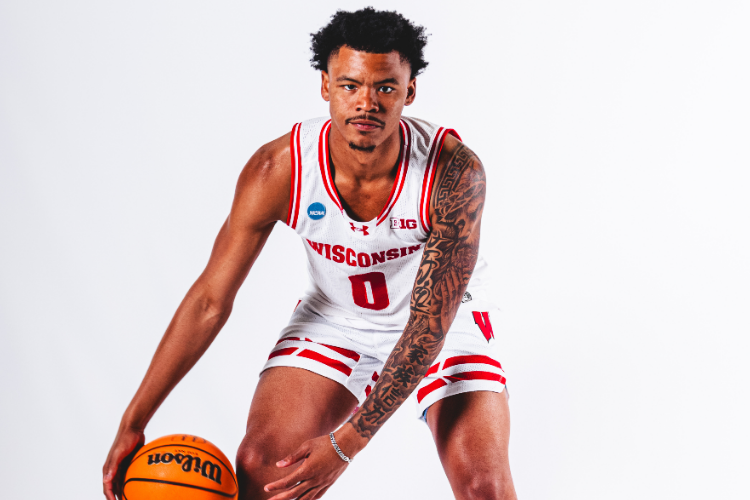
Trey Autry averaged 11 points, 3.5 rebounds and 1.5 assists per game at George Washington last season (Photo courtesy of Wisconsin Athletics).
VandeWettering said Wisconsin monitored Foxwell throughout last season, but he committed to LSU in February. When Foxwell reopened his recruitment following a coaching change at LSU, VandeWettering said “we weren’t going to let him slip through twice.” Foxwell is expected to start at point guard to replace Nick Boyd. Returning sophomore Zach Kinziger could serve as Foxwell’s backup. Wisconsin will have four players on the roster from New Zealand and Australia, with Foxwell, Jones, Jackson Ball and Isaac Riddle. Jones’ New Zealand connection to former Wisconsin assistant coach Kirk Penney helped to start the player shift, but VandeWettering said the Badgers have been intentional about building relationships with agents in the region to help continue the pipeline.
Wisconsin lost four players to the transfer portal this offseason: guards Jack Robison and John Blackwell and forwards Riccardo Greppi and Alesksas Bieliauskas. Robison and Greppi were scout-team players who sought more playing time, with Robison signing with North Dakota State and Greppi joining Sam Houston. The departures of Blackwell and Bieliauskas were particularly notable given that Bieliauskas started as a true freshman and Blackwell was a multi-year starter who finished second on the team in scoring last season. Blackwell signed with Duke and Bieliauskas went to South Carolina.
VandeWettering said there was a clear discrepancy between where Bieliauskas’ representation viewed his market value after the season and where Wisconsin had his position slotted. Bieliauskas started 28 games and ranked seventh on the team in scoring and third in rebounds per game.
VandeWettering noted Wisconsin had discussions with both Blackwell and his agent throughout the year “to take a pulse on where things were at, where they felt like his market was and then make a decision on our side as well of what fit within our strategy of how we wanted to disburse our resources across the roster.”
“It wasn’t a surprise I would say that was the decision that was made,” VandeWettering said. “While having these conversations, we were making contingency plans that if this happens, then this. Or if that happens, then it’s this so we’re prepared for anything.
“Once those conversations were had and it became clear what needed to happen, we were able to pivot pretty quickly and make sure that we were well-positioned to put the team together that we wanted to put together.”
One of the big questions VandeWettering said he and the staff considers every offseason is what percentage of resources to allocate to the top end of the roster while still having financial flexibility to build an impactful playing rotation with, for example, the four through nine players. Those numbers shift as Wisconsin evaluates different options.
“We study a lot of NBA teams of how they go about building their rosters with the stars that they have and how their funds are allocated percentage-wise to see what makes sense for us,” VandeWettering said. “So there’s a lot of research that goes into it to try to figure out what is the sweet spot there? I don’t know if there’s a perfect answer every year, but it’s at least a good guide for us to have so that we’re not over- or under-investing in a certain sector of the rotation and the roster as a whole.”
Wisconsin’s roster-building approach in the NIL age is one of financial discipline, which means being selective in which transfer portal players to pursue and which current players to retain. But VandeWettering said that does not mean the Badgers don’t have a competitive budget or the ability to add and retain high-end talent. Securing Winter for his senior season represented a major victory. Wisconsin’s pool of resources increased this offseason, though it’s worth noting that the same can be said for many other programs in the NIL arms race. The Badgers also have been able to point to their ability to develop portal players in each of the past three seasons with A.J. Storr, John Tonje and Boyd.
“The teams that we were able to knock off this past year, at Michigan, Illinois twice, Michigan State and at Purdue, there’s a lot of proof there that the decisions you make and how you use your resources is almost as important as how much resources you have,” VandeWettering said. “Without naming names, I think you can look across the country on teams that have an incredible amount of resources. But if you make bad decisions and it doesn’t come together, is more always better?
“I think the strategy, the intentionality that you go in with, the evaluations you put together and knowing how you want to build a team and being very intentional about the decisions you make with the resources you have, it will set you up for success. Past history shows that we’ve got a pretty good track record of how that’s come together for us.”
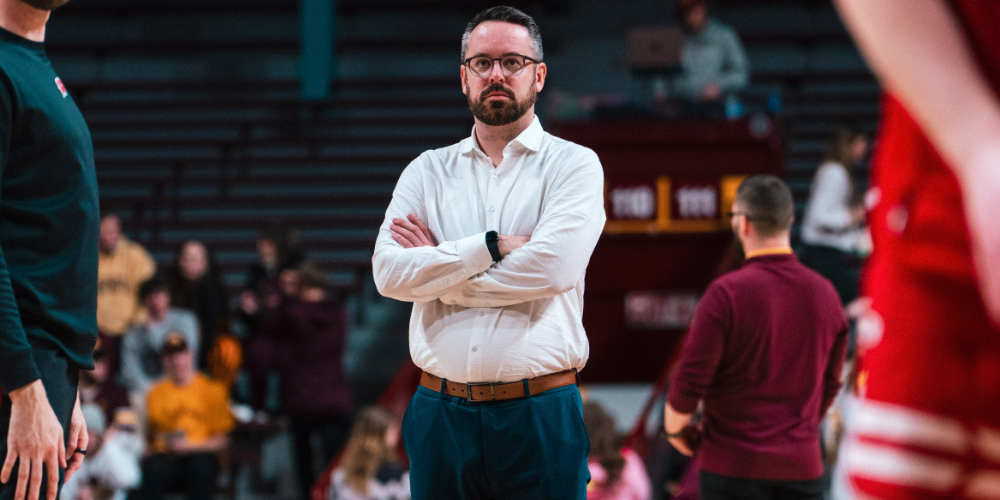
(Top photo of Marc VandeWettering courtesy of Wisconsin Athletics)